
Chapter 1 - The Outer Atmosphere
The Outer Atmosphere | Loving Wisdom
A calm introduction to the outer atmosphere as a subtle meeting place between Earth, moon, planets and human thought.
This opening chapter presents the outer atmosphere as a subtle communicator between Earth and the wider cosmos, receiving lunar and planetary influences while also transmitting the thoughts of mankind and the elemental kingdoms.
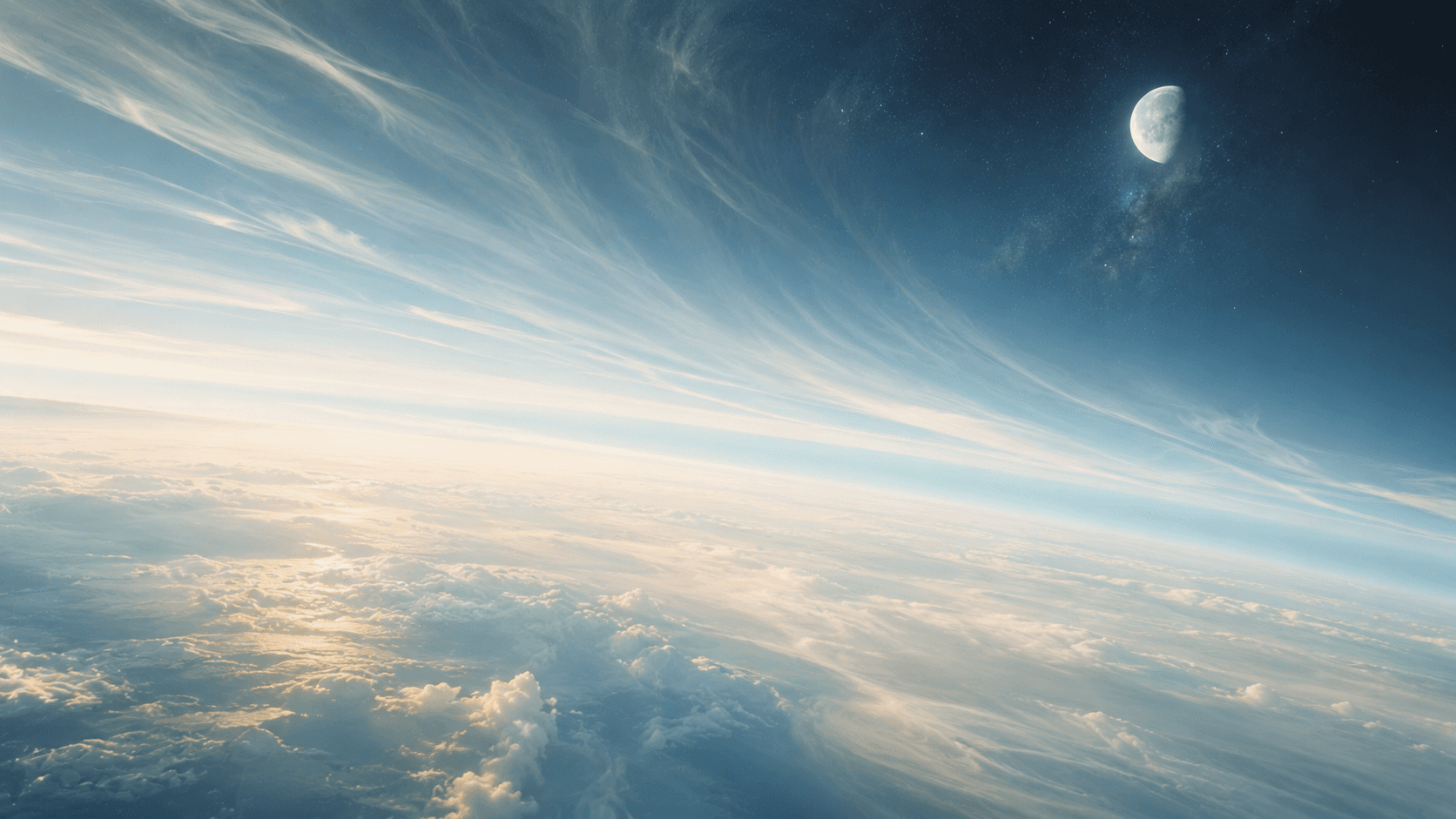
At the outer edge of the atmosphere, the book begins not with human life, but with a wide, almost silent threshold. The rarest air is shown as the place where Earth’s own power has thinned, where the pull of the ground is weaker, and where lunar and planetary influences can be received before they become part of earthly life. Instead of treating the sky as empty distance, the teaching gives it presence: a subtle meeting field between Earth, moon, planets, stars and thought.
The atmosphere here is not passive. It listens, receives, changes and carries. Cosmic influences are described as too direct for mankind and the other kingdoms to meet in their raw form, so this outer region becomes a translator. Lunar and planetary vibrations are softened into more earthly frequencies, then filtered down through denser layers of air until they can be felt within the living world. The image is clear and memorable: the outer atmosphere reaches outward like an aerial into the cosmos, gathering signals that would otherwise remain beyond ordinary perception.
That same aerial does not only receive. It also transmits. Human thought, together with the activity of the elemental kingdoms, is described as moving outward through this atmospheric field. Thought is therefore not treated as a private event sealed inside the mind. It becomes part of a larger exchange, carried within the subtle weather of the world. The reader is invited to imagine consciousness as something that participates in the atmosphere, and the atmosphere as something that responds to consciousness.
The teaching gives special weight to moonlight. Sunlight is associated with direct life force, energy and growth; moonlight is described as a gentler, soul-related influence that can be sustained because it is filtered through the higher atmosphere. The moon’s power is not presented as merely decorative or romantic. It forms a protective and harmonising vibration around the Earth, like a silver lining around a globe, holding the sphere together and helping the kingdoms receive what would otherwise be too intense.
The full moon becomes the moment of greatest balance. In the book’s language, sun and moon come into alignment so that positive and negative, direct and reflected, solar and lunar, can complement one another. When the balance is right, mankind, animals, plants, crystals and rocks are all said to respond more fully. The word “lunacy” is reclaimed from its ordinary negative meaning and placed back into the rhythm of nature: lunar response is not disorder, but one of the old patterns of elemental life.
The teaching then draws the moon’s influence down from the visible sky into the hidden movements of the Earth. The tides of the oceans are only one expression of a wider lunar pulse. Beneath the surface, the chapter imagines a deeper magmic movement, an underground ebb and flow moving through the Earth like a heartbeat. Outer atmosphere, moon, sea, rock, magma and human life become connected through rhythm. What appears above also moves below.
As an opening, The Outer Atmosphere gives the whole book its scale. The journey begins at the planet’s furthest influence, yet immediately returns to the soul, the body, the kingdoms of nature and the thoughts people generate. It asks the reader to look at sky, moonlight and atmosphere differently: not as background scenery, but as living communication. Before the book moves into the Earth, water, air, Devas and mankind, it first establishes a universe in which everything is exchanging, translating and transmitting meaning.
Atmosphere as subtle communication
Lunar and planetary influence
Transmutation of cosmic energies
Human thought as broadcast
Rhythm, harmony and the full moon
On a clear evening, look up at the sky and notice it as a living threshold rather than empty space. Ask what it means to feel connected both to the Earth beneath you and to the wider cosmos above.
As the first chapter, The Outer Atmosphere establishes the book's layered view of reality. Earth, moon, atmosphere, elemental life and human thought are already shown as connected parts of one larger field.