
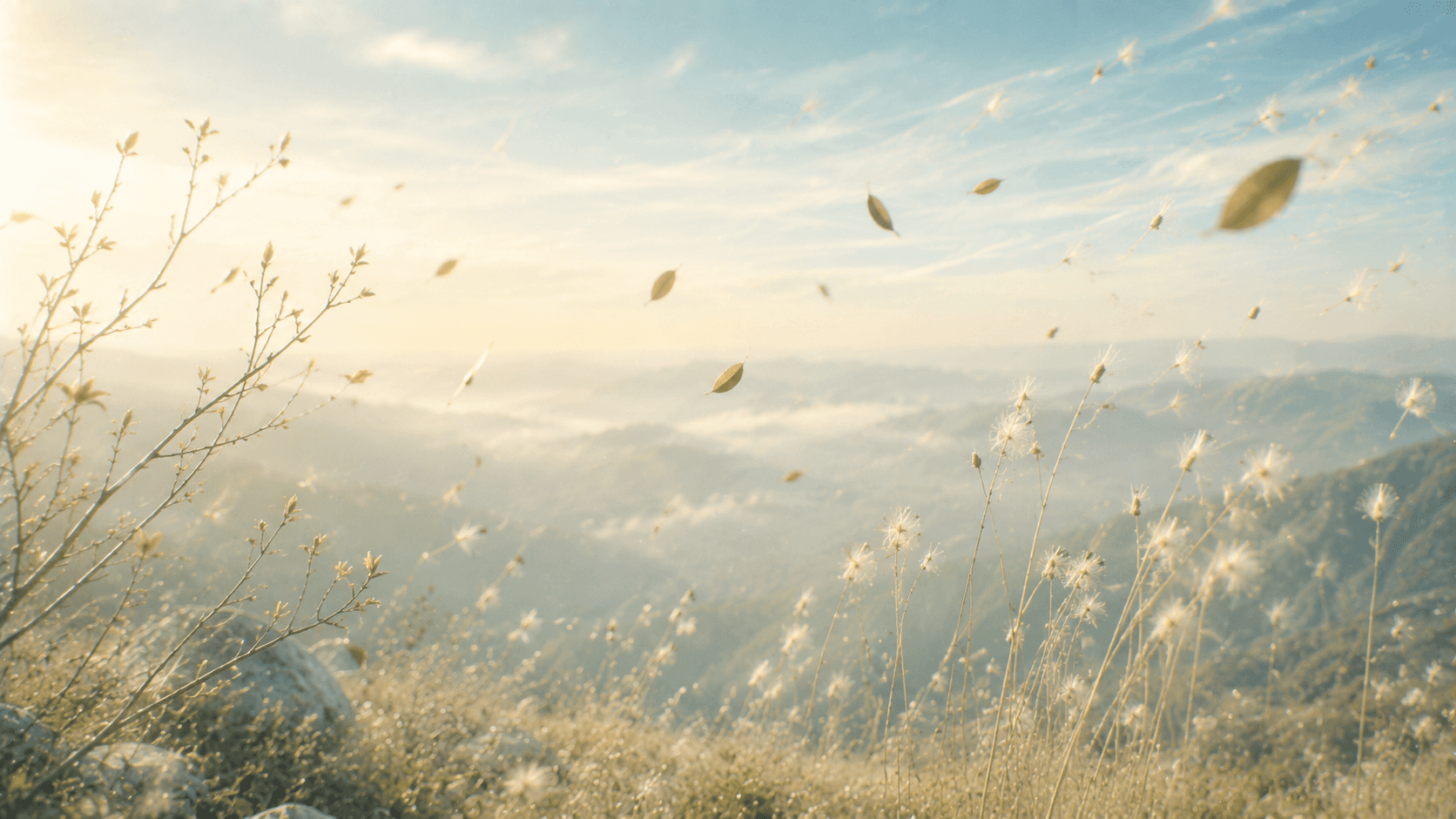
Chapter 25 - The Winds of Change
The Winds of Change | Loving Wisdom
A reflective reading of wind as a pattern of change, carrying subtle light through nature, seasons and mankind's evolution.
This chapter presents wind as more than movement in the air. It is described as a pattern, a grid and a messenger of change, scattering old forms and bringing new subtle light into nature, seasons and human awareness.
The Winds of Change arrives as a moving force rather than a quiet element. Wind is presented as a pattern that only comes into being when the air begins to move, a living structure that some may learn to perceive as grain, grid and over-grid. It is not treated merely as weather passing across the surface of things. It becomes the visible sign of change itself, the power that scatters seeds, clears dead leaves, brings rain, returns sunlight and keeps the whole natural world from becoming still and lifeless.
The teaching gives wind a double nature. On the familiar level, it changes seasons and landscapes. It opens the way for germination, removes what has weakened, and allows fresh growth to appear. On the subtler level, air is described as the medium of Light, and wind becomes one of the ways that new patterns of subtle Light enter the world. Plants are said to respond not only to physical temperature and daylight, but also to this change of frequency. Growth begins because something invisible has shifted.
That is why the phrase “winds of change” carries more than metaphor here. The wind is shown as one of the forces that can help initiate a new cycle of evolution. Old ideas, like dead leaves, are loosened and blown away. New growth, like spring buds, is warmed by the Light of a different era. The image is simple, but it gives the teaching its emotional force: renewal does not always arrive gently, and what makes space for life can also disturb what has become fixed.
The wind also humbles mankind. People may imagine themselves to be masters of the seasons, the land and the natural world, but wind is presented as a force beyond that control. It asks for inner understanding rather than domination. To link with the winds in humility would be to learn from the changing patterns they carry, instead of treating them as inconvenience, threat or background noise.
The dated references to a late spring, reduced harvest and unusual weather should be read as part of the transmission’s original moment, but the wider teaching remains clear. Change does not need to be instantly catastrophic in order to be profound. A season can shift by degrees. A harvest can diminish. Weather can confuse the vegetable kingdom when the inner Light and outer climate no longer seem to move together. The cumulative effect becomes the lesson.
There is also a social force in this image of wind. Mankind is shown as needing a shared pressure that breaks the illusion of control and makes people look again at their relationship with nature. A common disturbance may become a common teacher. The wind does not persuade through argument. It changes conditions, reveals dependence, and makes visible the fact that the human world is not separate from the cycles it tries to manage.
The wind therefore becomes both messenger and instrument. It moves through nature, but also through human thought. It removes the stale, exposes dependence, and makes clear that life is always turning toward another phase. For the reader, The Winds of Change invites a different attention to the moving air: not only as sensation on the skin, but as a sign that renewal often begins by loosening what can no longer remain.
Wind as an agent of change
Subtle light and seasonal renewal
Humility before natural forces
Cycles of transformation
Stand outside for a few minutes when the air is moving. Notice what the wind seems to clear, stir or awaken in you, without trying to control the feeling.
The Winds of Change extends the book's movement from earth, water and air into the larger theme of transition. It prepares the reader for the more cosmic chapters that follow by showing change first as something alive in the natural world.