Chapter 72 - The Deva of the Honey-Bee
The Deva of the Honey-Bee | Loving Wisdom
A closing chapter on the honey-bee as a lesson in group life, cooperation, unity and love.
This final chapter presents the Deva of the honey-bee as an invitation to cooperation between humans and bee Devic forces. It closes the book with unity, relationship and love.
The final chapter brings the long journey of elemental wisdom to one of the smallest and most communal creatures in the natural world. After the book has moved through atmosphere, Earth, water, cosmic forces, mankind’s purpose and the kingdoms of nature, the Deva of the honey-bee arrives with a message that is intimate rather than vast. The closing image is not a planet, mountain or star-field, but the living group life of bees.
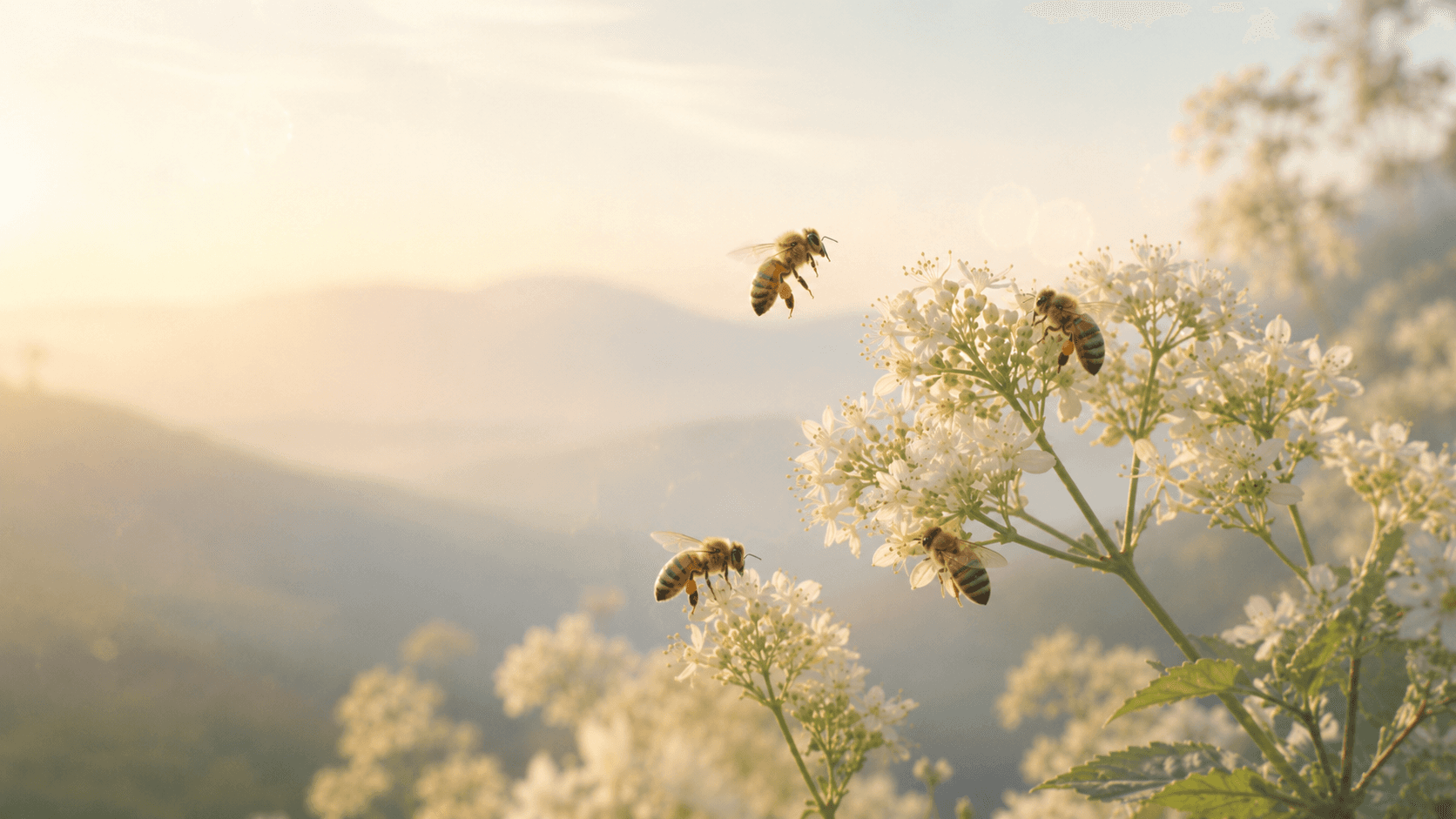
The honey-bee carries a different kind of teaching because it cannot be understood as a solitary being. In the language of the Deva, bees exist as a group before they exist as individuals. To speak to one bee is already to speak to the group. That single idea gathers many of the book’s earlier themes into a simple natural form: communication, cooperation, shared purpose, relationship with nature, and the movement from separateness toward unity.
The Deva invites a cooperative exercise between bee Devic forces and humans. The work is presented as something under-explored, practical and capable of beginning close to home. The reader is not asked to travel to a remote sacred site or master an abstract system. The experiment can start where one is living and continue wherever one moves. This gives the ending a quiet accessibility. The gateway into communion with nature may be as near as the bee moving through a garden or across a flower.
Communication here is described as both visual and intuitive. That matters because the chapter is not only about bees as a symbol; it is about learning a different form of relationship. The human mind is invited to notice, to address, to listen, and to understand that the natural world may be encountered through more than ordinary speech. Whether read literally or contemplatively, the teaching opens a softer attention: a willingness to meet a small creature as part of an intelligent pattern of life.
The honey-bee also becomes a mirror for humankind. The Deva speaks of bees as a good lesson for humans, because their life is inseparable from group being. Their purpose is not achieved through isolated self-expression, but through collective movement, shared direction and service to the whole. At the end of a book so concerned with mankind’s evolution, this is a striking final image. Human unity is not presented as an abstract ideal, but as something already enacted in nature by a creature often overlooked.
There is a lightness in the closing tone. The Deva expresses delight, anticipation and confidence. The work between humans and bee forces is not framed as a burden, but as a hopeful experiment that may produce surprising results. The phrase about “winning all the prizes” gives the chapter a buoyant quality, as though the final instruction is not solemnity but joyful cooperation. After so many teachings on change, responsibility and spiritual development, the book ends with encouragement.
The short closing note that follows widens the meaning once more. The reader is thanked for receiving the book, and the final direction is brought back to Source and love. The Deva of the honey-bee therefore acts as both ending and doorway: a reminder that love is not only a feeling, but a way of belonging to a larger life. The bees show unity in motion. They offer an image of what it might mean for mankind to live less separately, to communicate more subtly, and to let service become part of the shared pattern.
As a conclusion, The Deva of the Honey-Bee gathers the project’s deepest movement into a small, living form. The whole book has asked mankind to remember relationship with Earth, water, air, light, the Devas, the kingdoms and one another. The honey-bee closes that movement by showing relationship as everyday practice: communal, purposeful, attentive and alive. The final wisdom is not distant from the reader’s world. It hums close by, asking to be noticed.
The honey-bee as group being
Cooperation between humans and Devas
Communication with the natural world
Unity as a lesson for mankind
Love as the final direction
Notice the next bee, flower or small living creature you encounter. Let it remind you that life is not only individual, but cooperative and shared.
This final chapter closes Loving Wisdom from the Universe by returning the vast teaching of elemental wisdom to a small creature and a simple lesson: life is cooperative, consciousness is shared, and the deepest way forward is love.